
A sample size of one perspective into foster “failures,” capacity limits, and the complicated animals who sometimes need to stay.
If I had a dollar for every time someone said that to me, I could probably fund my own micro-rescue.
“I could never foster. I’d get too attached.”
“I’d keep them all.”
“I don’t know how you do it.”
Here’s the truth no one tells you:
Sometimes… we do keep them.
But my experience is it isn’t for the reasons people think.
There’s a romantic idea that fosters are constantly fighting the urge to hoard the cutest, cuddliest, most perfect animals that pass through their homes. And yes — they are cute. Yes — we love them. Yes — we cry every time when they leave. Every. Time.
But the ones that stay?
They’re usually not the “easy” ones.
They’re the complicated ones.
They’re the ones with the behavioral footnotes. The medical disclaimers. The “needs an experienced home” bios that make adoption inquiries go quiet if they even come in at all.
Let me introduce you to one of ours.
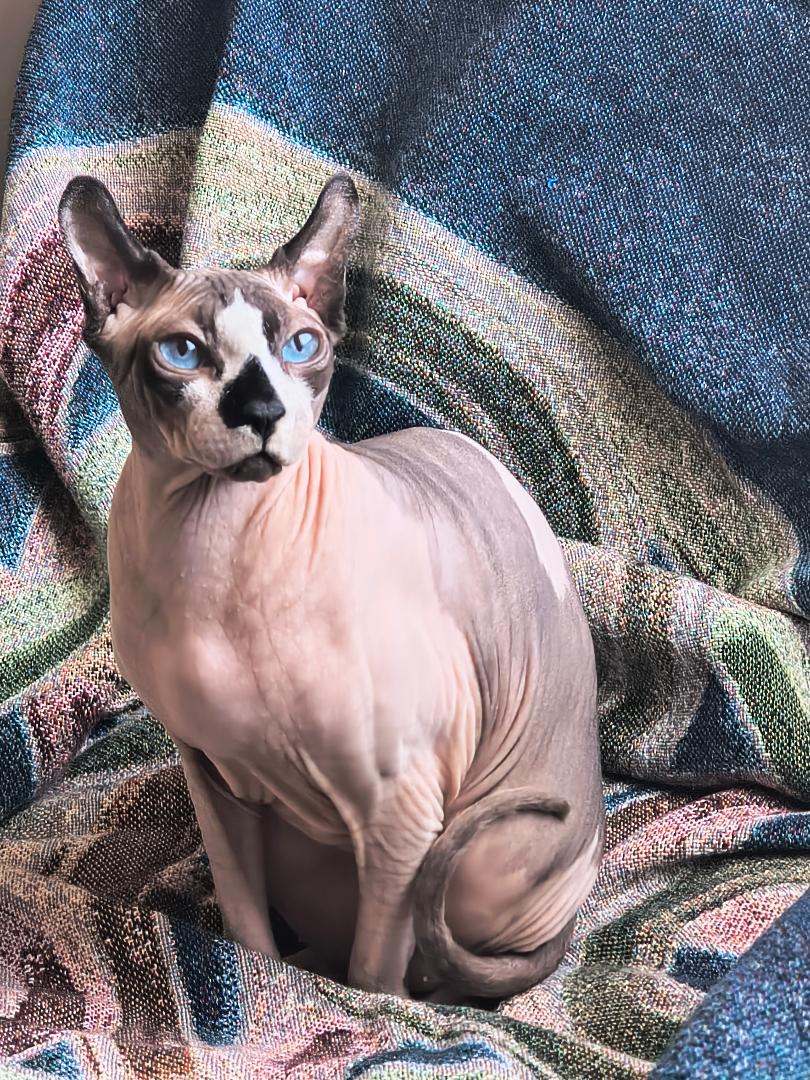
Meet Our Resident Chaos Goblin… Alfred 🐾
FIVE years ago, I made a post looking to adopt a Sphynx cat. My now best friend who rescues pedigreed cats with Sphynx being her passion, helped me locate one to be adopted and then I adopted another rescue from her later on so mine could have a friend.
Then, a year AFTER I had already adopted two Sphynx cats, I got a random Facebook message:
“Hey… I have a Sphynx you might want.”
Here enters Alfred.
The story was that he’d been taken in from a friend going through a divorce, but unfortunately Alfred was “beating up their Bengal” and had “behavioral issues.”
Now, if you know cats, you might pause here.
Sphynx: warm, Velcro, slightly needy baked potato.
Bengal: the Belgian Malinois of cats.
If you don’t know what a Belgian Malinois is, please Google it. I’ll wait.
Imagine that… but in cat form.
Naturally, I assumed there had to be some misunderstanding. I went to meet him fully prepared to foster and evaluate. His rehoming fee was minimal, I paid it, I picked him up. I was stunned.
He was gorgeous. Friendly. Social. Semi -wrinkly perfection. I remember thinking, “There’s no way this guy is the problem.”
Reader… he was the problem. 😅
Alfred is what we politely call “excessively busy.” He doesn’t just enter a room — he arrives. With opinions. And volume. And occasionally poor life choices.
He harassed everything and everyone. The dogs (who outweigh him by approximately 17 times). The other animals. The furniture. The concept of peace. My every last nerve.
If redirected from doing something he absolutely believed he should be doing, he would express his displeasure with inappropriate urine marking while making very intentional eye contact prior to.
Nothing says “I reject your authority” like peeing on something.
So yes — the Bengal allegations were, in fact, accurate.
We exhausted enrichment. Hormone plug-ins. Structured play. Increased one-on-one time. Environmental adjustments. Safe, controlled environmental outings. Boundaries. More enrichment. Did I mention enrichment?
Eventually, after responsibly ruling out potential medical causes and trying every behavioral tool in the toolbox, Alfred started medication.
And it helped.
He is still Alfred — but now he’s Alfred with slightly fewer hostile takeover attempts per day. Yes, you read that right, per day.
The Part People Don’t See
Sometimes we take in animals intending to rehabilitate and rehome them independently, especially when rescues are overwhelmed.
Sometimes they are beautiful, affectionate, hilarious creatures…with quirks that make them “not highly adoptable.”
And sometimes, as rescuers, we quietly realize that the safest place for them might be the one they’re already in.
Because here’s the reality:
The best-case scenario for a challenging animal placed in the wrong home is a return.
The worst-case scenario is disposal. It is a fear, it is real, it is valid. I see it happen every week.
And that worst case is the one that keeps us up at night.
So Alfred stayed.
Not because fostering “failed.”
Not because I couldn’t let go.
But because after evaluation, management, and honesty about his needs, our home was the one equipped to handle him safely and long-term.
But Here’s What Matters
If every foster kept every animal, rescue would collapse.
Capacity matters.
Every time we keep one, that’s one less spot available for the next emergency call. The next senior surrender. The next medical case. The next animal running out of time.
Most fosters don’t keep them all.
We move them through.
We prepare them.
We match them carefully.
We celebrate (and cry) when they leave.
And occasionally — when the math, the management, and the moral responsibility all point to it — one stays.
Those are the “hard” ones.
The project ones.
The ones who would bounce.
The ones who need someone already fluent in their chaos.
Alfred Today
He is ridiculous.
He is dramatic.
He is occasionally a menace.
He is deeply loved.
And if you visit our home, he will absolutely introduce himself — whether you’re ready or not.
And to anyone who says, “I could never foster — I’d keep them all.”
Maybe.
But maybe you’d save dozens more by not doing that.
And sometimes, the one you keep?
Is the one who truly had nowhere else to go. And that is ok.
 Fur The Love of Fostering
Leave a comment